

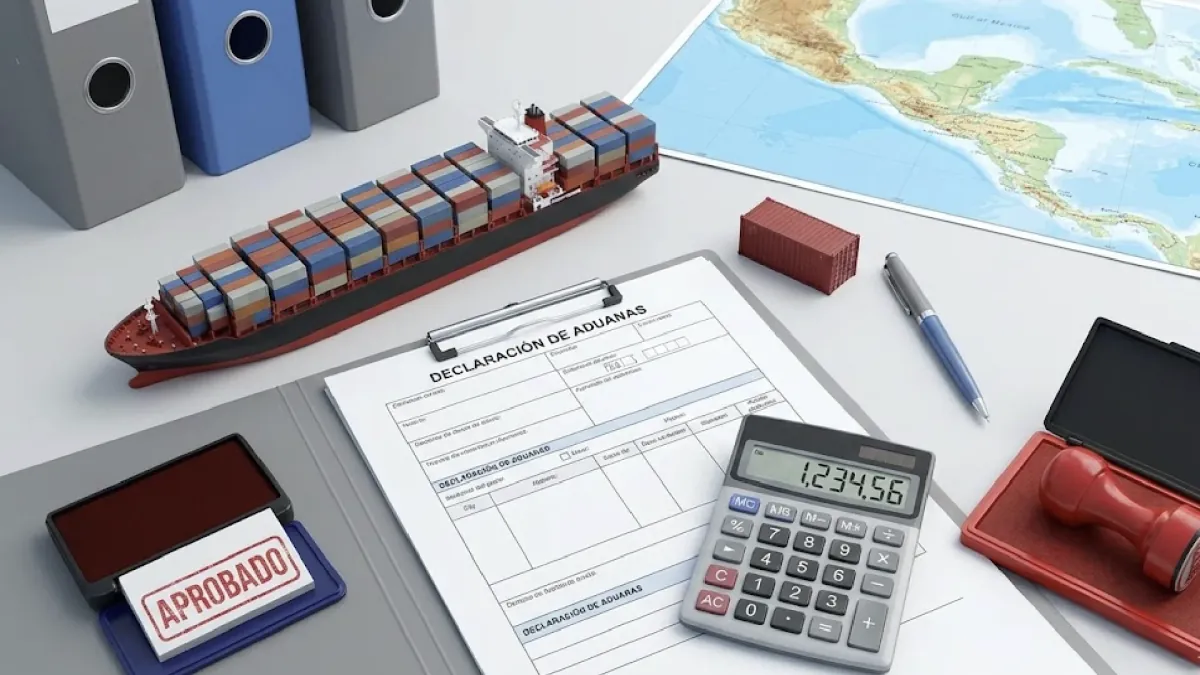
Central American import taxes have 3 layers: import duties (based on HS Code over CIF value), VAT/sales tax (12-15%), and local fees (port, handling, broker). Validating the correct HS Code before closing a deal is essential.
Customs and import taxes are often the most confusing part of bringing products into Central America.
Many importers focus on FOB or CIF prices from China—but lose margin at the port due to duties, VAT and local fees.
This guide explains customs and import taxes in simple, non-legal language so you can better understand your real landed cost.
1. The Three Main Cost Layers at Customs
When your shipment arrives in a Central American country, customs costs usually break down into three main layers:
- Import duties (based on HS Code)
- VAT or sales tax (applied on top of value + duties)
- Local fees and services (port, handling, broker, etc.)
Once you understand these layers, the final cost stops being “a mystery number” and becomes a calculable structure.
2. The HS Code: Where Everything Starts
Every product is classified under a Harmonized System (HS) Code, which determines:
- the duty rate,
- if special permits are required,
- if it qualifies for any exemptions or trade agreements.
Small changes in product description (for example, “plastic organizer” vs. “furniture part”) can change the HS Code and therefore the tax burden.
For a global reference on HS codes:
WCO Harmonized System Overview
3. How Customs Value Is Calculated
In most Central American countries, import duties are calculated over a CIF value:
CIF = Product Value + International Freight + Insurance
From there, the customs system calculates:
- Import duty (percentage over CIF)
- VAT or sales tax (percentage over CIF + duty + some local charges, depending on the country)
This is why underestimating freight or ignoring insurance leads to surprises at customs.
4. Import Duties: Not All Products Pay the Same
Duty rates vary by:
- HS Code
- Product type (industrial, consumer, raw material)
- Existing trade agreements
Examples (simplified):
- Some raw materials → low or zero duty
- Finished consumer goods → moderate duty
- “Sensitive” categories (e.g., some textiles or food) → higher duty or special controls
Rather than memorizing percentages, your priority should be:
confirm the correct HS Code before closing a deal.
5. VAT / Sales Tax at Import
VAT (or equivalent) is normally charged at the time of import:
- It is calculated on top of customs value + duties
- It can often be credited later if your company is a VAT-registered taxpayer
- For cash flow, it still matters—because you must finance it up front
Many importers underestimate the impact of VAT on working capital.
6. Local Fees That Impact Your Landed Cost
Beyond duties and VAT, you will face:
- Port handling fees
- Terminal and warehousing fees (if there are delays)
- Customs broker fees
- Documentation and inspection fees (if applicable)
Individually, these amounts may seem small; together, they can significantly change your cost per unit.
7. Documents Customs Will Check Carefully
To avoid delays, make sure these documents are clean and consistent:
- Commercial Invoice
- Packing List
- Bill of Lading (or Air Waybill)
- Certificates of origin or conformity (if required)
Any difference between quantities, values or descriptions will trigger questions—and possibly inspections.
8. A Simple Way to Think About Landed Cost
A practical mental formula:
Landed Cost ≈ Product Cost + International Logistics + Customs Layer (duties + VAT + local fees) + Inland Transport
When you treat customs as a layer in your pricing model rather than a “black box at the port”, your decisions become more strategic:
- You can compare different HS scenarios (within legal limits).
- You can choose between higher FOB / lower duty vs. lower FOB / higher duty.
- You can decide whether a product is viable before committing.
Need help understanding customs impact on your pricing?
Avoid risks and get better pricing with our sourcing experts.
Frequently Asked Questions
Quick answers to common questions about this topic
Import taxes have 3 layers: import duties (based on HS Code over CIF value), VAT or sales tax (12-15%), and local fees (port handling, brokerage, documentation).
The HS Code is a classification system that determines your duty rate, required permits, and trade agreement eligibility. A wrong HS Code can significantly change your tax burden.
Customs carefully reviews the Commercial Invoice, Packing List, Bill of Lading, and Certificates of Origin or Conformity. Any inconsistency between documents can trigger delays and inspections.