

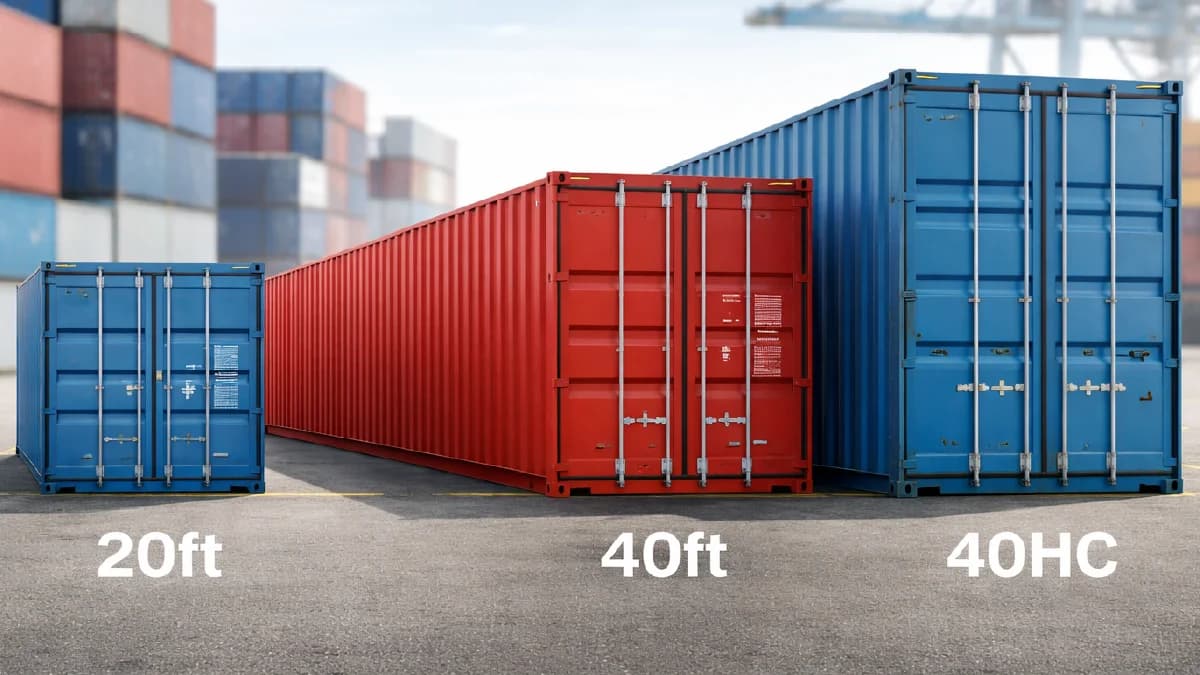
A 20ft container holds ~33 CBM and is best for heavy, dense cargo under 28 tons. A 40ft standard holds ~67 CBM for larger shipments. A 40ft High Cube adds 30cm height (~76 CBM) for tall or voluminous goods. Choose based on your cargo volume, weight, and the crossover point where FCL becomes cheaper than LCL.
Shipping containers are the backbone of global trade. Understanding their sizes, dimensions, and capacity is essential knowledge for anyone importing goods—it directly affects your costs, logistics planning, and operational decisions.
This guide covers the three most common container types: 20ft standard, 40ft standard, and 40ft High Cube. You'll learn their exact dimensions, weight limits, and how to choose the right one for your shipment.
The Three Main Container Types
20ft Standard Container (20' GP/DV)
The 20-foot container is the original standard and remains widely used for dense, heavy cargo.
| Specification | Imperial | Metric |
|---|---|---|
| External Length | 20 ft | 6.06 m |
| External Width | 8 ft | 2.44 m |
| External Height | 8 ft 6 in | 2.59 m |
| Internal Length | 19 ft 4 in | 5.90 m |
| Internal Width | 7 ft 8 in | 2.35 m |
| Internal Height | 7 ft 10 in | 2.39 m |
| Door Width | 7 ft 8 in | 2.34 m |
| Door Height | 7 ft 6 in | 2.28 m |
| Cubic Capacity | 1,172 cu ft | 33.2 CBM |
| Tare Weight | 4,916 lbs | 2,230 kg |
| Max Payload | 61,795 lbs | 28,030 kg |
Best for: Heavy, dense cargo where you'll hit weight limits before volume limits. Metal parts, machinery, stone, liquids.
40ft Standard Container (40' GP/DV)
The 40-foot standard offers double the length of a 20ft at roughly 1.5x the cost.
| Specification | Imperial | Metric |
|---|---|---|
| External Length | 40 ft | 12.19 m |
| External Width | 8 ft | 2.44 m |
| External Height | 8 ft 6 in | 2.59 m |
| Internal Length | 39 ft 5 in | 12.03 m |
| Internal Width | 7 ft 8 in | 2.35 m |
| Internal Height | 7 ft 10 in | 2.39 m |
| Door Width | 7 ft 8 in | 2.34 m |
| Door Height | 7 ft 6 in | 2.28 m |
| Cubic Capacity | 2,390 cu ft | 67.7 CBM |
| Tare Weight | 8,160 lbs | 3,700 kg |
| Max Payload | 59,040 lbs | 26,780 kg |
Best for: Balanced cargo with moderate density. General merchandise, furniture, consumer goods.
40ft High Cube Container (40' HC)
The High Cube adds 1 foot (30cm) of height, providing approximately 13% more volume than a standard 40ft.
| Specification | Imperial | Metric |
|---|---|---|
| External Length | 40 ft | 12.19 m |
| External Width | 8 ft | 2.44 m |
| External Height | 9 ft 6 in | 2.90 m |
| Internal Length | 39 ft 5 in | 12.03 m |
| Internal Width | 7 ft 8 in | 2.35 m |
| Internal Height | 8 ft 10 in | 2.70 m |
| Door Width | 7 ft 8 in | 2.34 m |
| Door Height | 8 ft 6 in | 2.58 m |
| Cubic Capacity | 2,694 cu ft | 76.3 CBM |
| Tare Weight | 8,750 lbs | 3,970 kg |
| Max Payload | 58,450 lbs | 26,510 kg |
Best for: Light, voluminous cargo. Furniture, foam products, clothing, toys, plastic goods.
Quick Comparison Table
| Feature | 20ft | 40ft | 40ft HC |
|---|---|---|---|
| Length (internal) | 5.90 m | 12.03 m | 12.03 m |
| Height (internal) | 2.39 m | 2.39 m | 2.70 m |
| Volume (CBM) | 33 | 67 | 76 |
| Usable CBM | ~28 | ~58 | ~68 |
| Max Payload | 28,030 kg | 26,780 kg | 26,510 kg |
| Euro Pallets | 11 | 23-24 | 23-24 |
| US Pallets | 10-11 | 20-21 | 20-21 |
Pallet Loading Capacity
Understanding pallet fit helps you plan efficient loading:
Euro Pallets (120cm × 80cm / 47" × 31")
- 20ft container: 11 pallets (single layer)
- 40ft container: 23-24 pallets (single layer)
US Standard Pallets (48" × 40" / 122cm × 102cm)
- 20ft container: 10 pallets (single layer)
- 40ft container: 20-21 pallets (single layer)
Note: These are floor-loaded counts. Total pallets depend on stacking capability, which depends on product weight, fragility, and pallet height.
Weight vs Volume: Understanding the Trade-off
Here's a critical concept many new importers miss:
20ft containers have higher weight capacity relative to their volume.
This means:
- 20ft: Can carry ~850 kg per CBM before hitting limits
- 40ft/HC: Can carry ~400 kg per CBM before hitting limits
For dense, heavy products (metal, ceramics, stone), a 20ft container may be more efficient because you'll fill the weight capacity before running out of space.
For light, bulky products (furniture, toys, textiles), 40ft HC maximizes value because you'll fill the space before hitting weight limits.
When to Use Each Container
Choose 20ft when:
- Cargo is heavy relative to volume (density > 500 kg/CBM)
- Shipment is 15-28 CBM
- Destination has infrastructure limitations for 40ft containers
- You want lower absolute cost (even if per-CBM is higher)
- You need more flexibility in trucking and handling
Choose 40ft Standard when:
- Cargo has moderate density
- Shipment is 30-55 CBM
- You need balanced cost efficiency
- Standard height (2.39m) is sufficient for your products
Choose 40ft High Cube when:
- Cargo is light and bulky
- Products are tall (furniture, equipment)
- Shipment exceeds 55 CBM
- You're shipping cartons that stack high
- The extra cost (~$100-200) is justified by 13% more space
Real-World Cost Comparison
Let's look at a practical example. You're shipping 24 CBM of consumer goods from China to Central America.
Option 1: LCL
- Rate: $70 per CBM
- Cost: 24 × $70 = $1,680
Option 2: 20ft FCL
- Rate: $2,200 all-in
- Cost per CBM: $2,200 ÷ 28 usable CBM = $78.57
Option 3: 40ft FCL (if you could increase order)
- Rate: $3,200 all-in
- Cost per CBM: $3,200 ÷ 58 usable CBM = $55.17
In this scenario, LCL is slightly cheaper for 24 CBM. But if you could increase to 28 CBM, FCL becomes competitive. And if you could fill a 40ft, the per-CBM rate drops significantly.
The crossover point varies by route, season, and carrier—but typically falls between 12-18 CBM for 20ft and 35-45 CBM for 40ft.
Specialty Container Types
Beyond standard dry containers, other types exist for specific cargo:
Open Top
- No fixed roof (tarpaulin cover)
- For tall cargo that can't fit through doors
- Loading by crane from above
Flat Rack
- No walls or roof
- For oversized, heavy machinery
- Can extend beyond container footprint
Refrigerated (Reefer)
- Temperature controlled (-30°C to +30°C)
- For perishables, pharmaceuticals
- Slightly smaller internal dimensions due to insulation
High Cube Pallet Wide
- Extra width for efficient pallet loading
- Common in European routes
- Holds 30 Euro pallets vs 24 in standard
Practical Tips for Container Selection
Calculate your CBM accurately. Underestimating leads to cargo that won't fit; overestimating means paying for unused space.
Consider weight distribution. Heavy cargo should be spread evenly and placed low. Concentrated weight can cause handling problems or damage.
Account for loading efficiency. You won't achieve 100% utilization. Plan for 85-90% with normal cargo shapes.
Check inland restrictions. Some destinations have road or bridge limitations that favor 20ft over 40ft containers.
Ask about availability. Some routes have better availability of certain container types. Your forwarder can advise.
Final Thoughts
Container selection isn't just about fitting your cargo—it's about optimizing your total logistics cost. The right container depends on your specific cargo characteristics, shipment size, and route economics.
When in doubt, request quotes for multiple options. A few dollars per CBM difference compounds across regular shipments. And remember: the cheapest container isn't always the best value if it doesn't match your cargo profile.

Need help optimizing your container shipments?
Avoid risks and get better pricing with our sourcing experts.
Frequently Asked Questions
Quick answers to common questions about this topic
External: 20ft × 8ft × 8.6ft (6.1m × 2.4m × 2.6m). Internal: 19.4ft × 7.8ft × 7.9ft (5.9m × 2.35m × 2.39m). Volume: ~33 CBM total, ~28 CBM usable. Max payload: ~28,000 kg.
A 40ft High Cube is 1 foot (30cm) taller than a standard 40ft container. Standard 40ft: 8.6ft high, 67 CBM. High Cube: 9.6ft high, 76 CBM. Use HC for tall goods or to maximize volume for light cargo.
A 20ft container fits 10-11 standard pallets (48×40 inches) or 11 Euro pallets (120×80 cm) in a single layer. A 40ft container fits 20-21 standard pallets or 23-24 Euro pallets floor-loaded.