

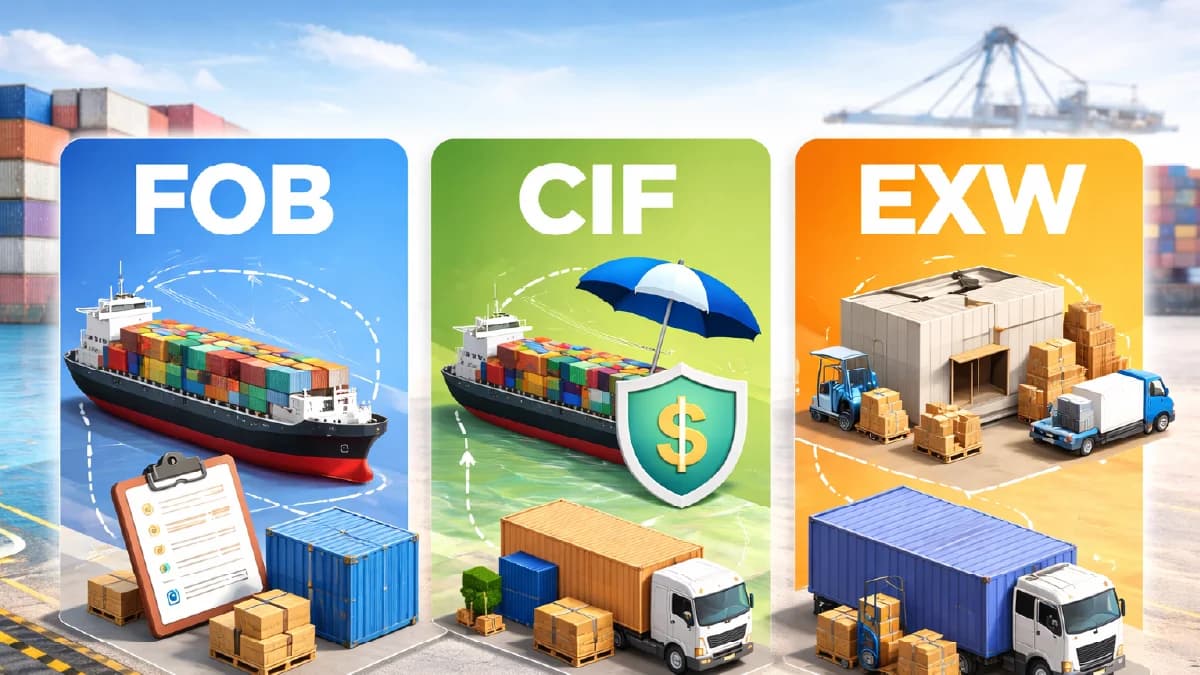
FOB (Free On Board) is generally the safest choice for importers because you control the freight and avoid hidden fees. CIF (Cost, Insurance, Freight) is convenient but risky with new suppliers. EXW (Ex Works) gives maximum control but also maximum responsibility. Choose based on your experience level and supplier trust.
You've found a supplier, negotiated the price, and you're ready to place your order. Then comes the question that confuses many importers: should you buy FOB, CIF, or EXW?
The answer matters more than you might think. Choosing the wrong incoterm can add thousands of dollars to your costs, create logistical nightmares, or leave you with no control over your own shipment.
This guide breaks down the three most common incoterms used in imports from China and Asia, explains when to use each one, and helps you avoid the expensive mistakes that catch many importers off guard.
What Are Incoterms?
Incoterms (International Commercial Terms) are standardized trade terms published by the International Chamber of Commerce. They define who is responsible for what during international shipping—specifically, who pays for transport, insurance, and customs at each stage, and when risk transfers from seller to buyer.
There are 11 incoterms in total, but three dominate imports from China:
- EXW (Ex Works)
- FOB (Free On Board)
- CIF (Cost, Insurance, and Freight)
Each shifts the balance of responsibility, cost, and risk differently between you and your supplier.
FOB: The Importer's Preferred Choice
FOB (Free On Board) means the supplier is responsible for getting the goods loaded onto the ship at the origin port. Once the goods are on board, responsibility transfers to you.
What the supplier handles:
- Product manufacturing and packaging
- Inland transport to the port in China
- Export customs clearance
- Loading onto the vessel
What you handle:
- Ocean freight from origin to destination
- Cargo insurance
- Import customs clearance
- Duties and taxes
- Inland transport to your warehouse
Why FOB is usually the best choice:
You control the freight. When you book the shipping yourself, you know exactly what you're paying. You choose your freight forwarder, compare rates, and avoid surprises.
No hidden destination charges. With CIF, the seller's agent at destination often adds inflated fees. With FOB, your own agent handles arrival, and you know the real costs.
Better negotiating position. Freight rates vary. By controlling this piece, you can shop around and potentially save significant money, especially on large shipments.
Clearer accountability. If something goes wrong during shipping, you're dealing with a forwarder you chose and have a relationship with, not a third party appointed by your supplier.
When FOB makes sense:
- You have a reliable freight forwarder
- You want full visibility into shipping costs
- You're working with a new supplier you don't fully trust yet
- Your shipment volume justifies managing logistics yourself
CIF: Convenient but Risky
CIF (Cost, Insurance, and Freight) means the supplier handles everything until the goods arrive at your destination port. They arrange the freight, pay for it, and include basic insurance.
What the supplier handles:
- Everything in FOB, plus:
- Ocean freight to your port
- Cargo insurance (minimum coverage)
What you handle:
- Import customs clearance
- Duties and taxes
- Destination port charges
- Inland transport to your warehouse
The hidden problem with CIF:
On paper, CIF sounds easier. The supplier takes care of shipping, and you just wait for goods to arrive. But here's what often happens in practice:
The supplier books the cheapest possible freight through their preferred agent. That agent has a partner at your destination port. When your goods arrive, that partner—not you—is listed as the consignee on the bill of lading.
To release your goods, you must pay whatever "destination charges" this agent demands. These charges are often 3 to 5 times higher than market rates. You have no choice but to pay, because they control your cargo.
This practice is extremely common in imports from China, especially for LCL (less than container load) shipments. It's not technically illegal, but it's a trap that costs importers thousands of dollars.
When CIF might work:
- You have an established, trusted supplier
- The supplier agrees to consign goods directly to you or your agent
- You've verified the destination charges in advance
- The convenience genuinely outweighs the risk
Red flags with CIF:
- The CIF price seems surprisingly low compared to FOB
- The supplier is vague about who handles destination
- You can't get clear answers about port charges
EXW: Maximum Control, Maximum Responsibility
EXW (Ex Works) means the supplier's only obligation is to make the goods available at their premises (usually the factory). Everything else—from loading the truck to export customs to ocean freight—is your responsibility.
What the supplier handles:
- Manufacturing the product
- Making it available for pickup
What you handle:
- Loading at the factory
- Inland transport in China
- Export customs clearance in China
- Ocean freight
- Insurance
- Import customs clearance
- Duties and taxes
- Inland transport to your warehouse
Why importers choose EXW:
Lower product price. Since the supplier isn't including any logistics costs, the unit price is often lower than FOB.
Total supply chain control. You manage every step, which can be valuable for complex or sensitive shipments.
Consolidated shipments. If you're buying from multiple factories and consolidating into one container, EXW lets your agent pick up from each location.
The challenges with EXW:
You need boots on the ground. Export customs in China requires documentation and expertise. Without an agent or partner there, you can't execute EXW effectively.
You inherit all origin-side risk. If something goes wrong before the goods reach the port—a trucking delay, a customs issue—it's your problem, not the supplier's.
More complexity. Managing Chinese export procedures from abroad adds layers of coordination and potential for mistakes.
When EXW makes sense:
- You have a sourcing agent or partner in China
- You're consolidating orders from multiple suppliers
- You're experienced and want granular control
- The cost savings justify the added complexity
Quick Comparison Table
| Aspect | EXW | FOB | CIF |
|---|---|---|---|
| Supplier responsibility | Minimal | Until loaded on ship | Until arrival at port |
| Buyer control | Maximum | High | Low |
| Risk of hidden fees | Low | Low | High |
| Requires China agent | Yes | No | No |
| Best for | Experienced importers | Most importers | Trusted suppliers only |
| Price transparency | Highest | High | Lower |
How Incoterms Affect Your Landed Cost
The incoterm you choose directly impacts your total landed cost calculation.
With FOB: You add your known freight costs to the FOB price. Your landed cost calculation is straightforward because you control the shipping quote.
With CIF: The freight is bundled into the price, but destination charges are unknown until arrival. Your landed cost estimate has higher uncertainty.
With EXW: The product price is lowest, but you must accurately estimate origin-side logistics to avoid surprises.
For accurate cost planning, FOB typically provides the clearest picture. You know the product cost, and you can get reliable freight quotes from your forwarder.
Negotiating Incoterms with Suppliers
Most Chinese suppliers prefer CIF because it gives them control and often includes hidden margins on freight. Don't be surprised if they push back when you request FOB.
How to negotiate:
Start by requesting FOB quotes alongside any CIF offers. Compare the difference—if FOB is only slightly higher than CIF, that's a red flag that they're padding the CIF freight.
Explain that you have your own freight forwarder and prefer to manage shipping directly. Professional suppliers understand this is standard practice for experienced importers.
If they insist on CIF, ask specifically who will be consigned on the bill of lading and what destination charges will apply. Get this in writing before agreeing.
Common Mistakes to Avoid
Choosing CIF just because it's easier. The convenience isn't worth the risk with suppliers you don't know well. The "easy" option often becomes expensive.
Using EXW without China support. If you don't have an agent or partner handling the origin side, EXW creates more problems than it solves.
Ignoring the incoterm in negotiations. Focusing only on unit price while ignoring the incoterm can lead to nasty surprises. A $10 FOB price is very different from a $10 CIF price.
Assuming all suppliers operate the same way. Some suppliers are completely trustworthy with CIF. Others will exploit it. Evaluate each relationship individually.
Our Recommendation
For most importers, especially those newer to importing from China: start with FOB.
It gives you control, transparency, and protection from the hidden fees that plague CIF shipments. As you build relationships with specific suppliers and gain confidence in your logistics, you can consider other arrangements.
If you're an experienced importer with a sourcing team in China, EXW might make sense for cost optimization and consolidated shipments.
Reserve CIF only for suppliers you've worked with for years and completely trust—or for situations where you've verified all destination arrangements in advance.
Need help choosing the right incoterm for your shipment?
Avoid risks and get better pricing with our sourcing experts.
Frequently Asked Questions
Quick answers to common questions about this topic
With FOB, the buyer controls and pays for freight from the origin port. With CIF, the seller arranges freight and insurance, but the buyer often faces inflated destination charges. FOB gives you more control; CIF is more convenient but riskier.
FOB is generally recommended for importing from China. It gives you control over shipping costs, lets you choose your freight forwarder, and avoids the hidden fees that often come with CIF shipments from unfamiliar suppliers.
EXW (Ex Works) means you're responsible for everything from the factory door. Use it only when you have a trusted agent in China who can handle export customs and local logistics. It offers the most control but requires local expertise.