

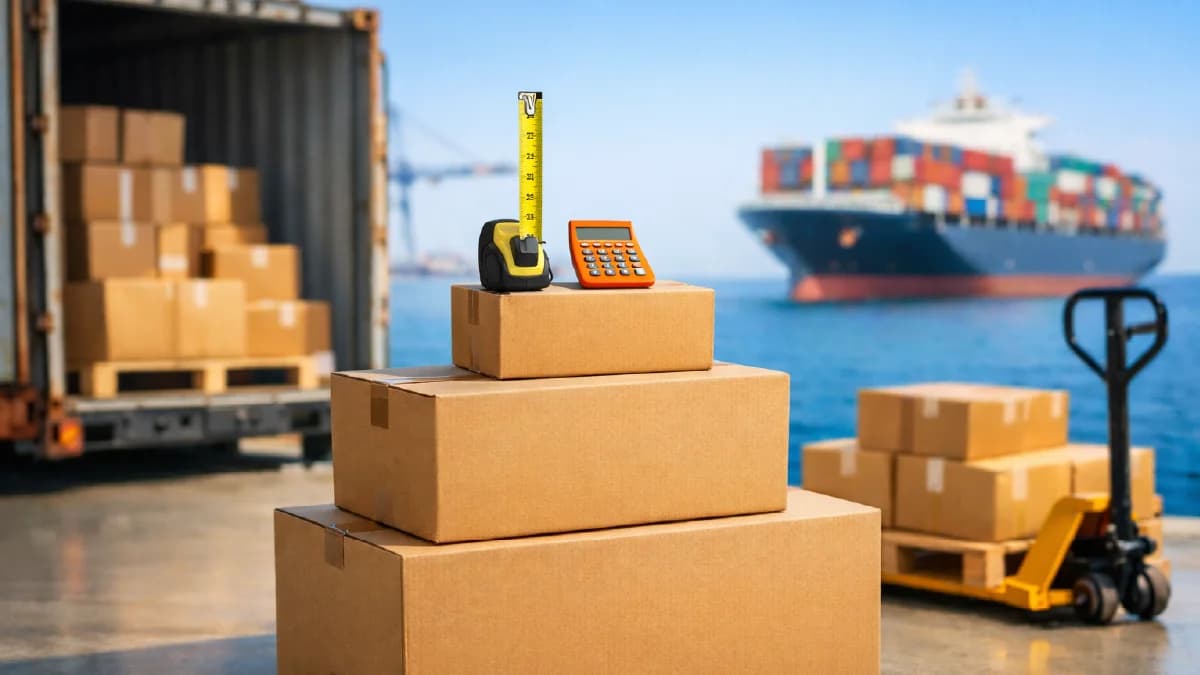
CBM (Cubic Meter) is calculated by multiplying Length × Width × Height in meters. For multiple boxes, calculate each box's CBM and multiply by quantity. CBM determines your ocean freight costs for LCL shipments and helps you understand how much space your cargo will occupy in a container.
When you request a shipping quote for goods from China, one of the first questions you'll hear is: "What's the CBM?" If you can't answer accurately, you can't get an accurate quote—and you might end up paying for space you don't use or scrambling because your cargo doesn't fit.
CBM calculation is fundamental to import logistics. It determines your ocean freight costs, helps you choose between shipping methods, and tells you whether your order will fit in a container. This guide shows you exactly how to calculate it.
What is CBM?
CBM stands for Cubic Meter—the standard unit for measuring cargo volume in international shipping. One cubic meter equals the space occupied by a cube measuring 1 meter on each side.
Freight companies use CBM to:
- Quote prices for LCL (Less than Container Load) shipments
- Calculate how much cargo fits in a container
- Determine whether your shipment should go LCL or FCL
- Estimate warehouse storage costs
The Basic CBM Formula
The formula is simple:
CBM = Length (m) × Width (m) × Height (m)
For multiple cartons of the same size:
Total CBM = Length × Width × Height × Quantity
Example calculation:
You have 100 cartons, each measuring 60cm × 40cm × 50cm.
Step 1: Convert centimeters to meters (divide by 100)
- 60cm = 0.6m
- 40cm = 0.4m
- 50cm = 0.5m
Step 2: Calculate CBM per carton
- 0.6 × 0.4 × 0.5 = 0.12 CBM
Step 3: Calculate total CBM
- 0.12 CBM × 100 cartons = 12 CBM total
Converting from Other Units
Not everyone measures in centimeters. Here's how to convert:
From inches:
1 inch = 2.54 cm = 0.0254 meters
Formula: (Length in inches × 0.0254) × (Width × 0.0254) × (Height × 0.0254)
From feet:
1 foot = 0.3048 meters
Formula: (Length in feet × 0.3048) × (Width × 0.3048) × (Height × 0.3048)
Quick reference:
| Measurement | To convert to meters |
|---|---|
| Centimeters | Divide by 100 |
| Millimeters | Divide by 1,000 |
| Inches | Multiply by 0.0254 |
| Feet | Multiply by 0.3048 |
CBM vs Weight: Which Determines Your Cost?
Ocean freight for LCL shipments is typically quoted per CBM, but there's a catch: freight companies also consider weight.
The standard rule is 1 CBM = 1,000 kg for billing purposes.
This means:
- If your 12 CBM shipment weighs 8,000 kg (less than 12,000 kg), you pay for 12 CBM
- If your 12 CBM shipment weighs 15,000 kg (more than 12,000 kg), you pay for 15 CBM equivalent
This is called chargeable weight or freight ton. You're charged on whichever is higher: actual volume or volumetric weight.
Light, bulky goods (furniture, toys, plastic items) are charged by CBM. Dense, heavy goods (metal parts, stone, machinery) may be charged by weight.
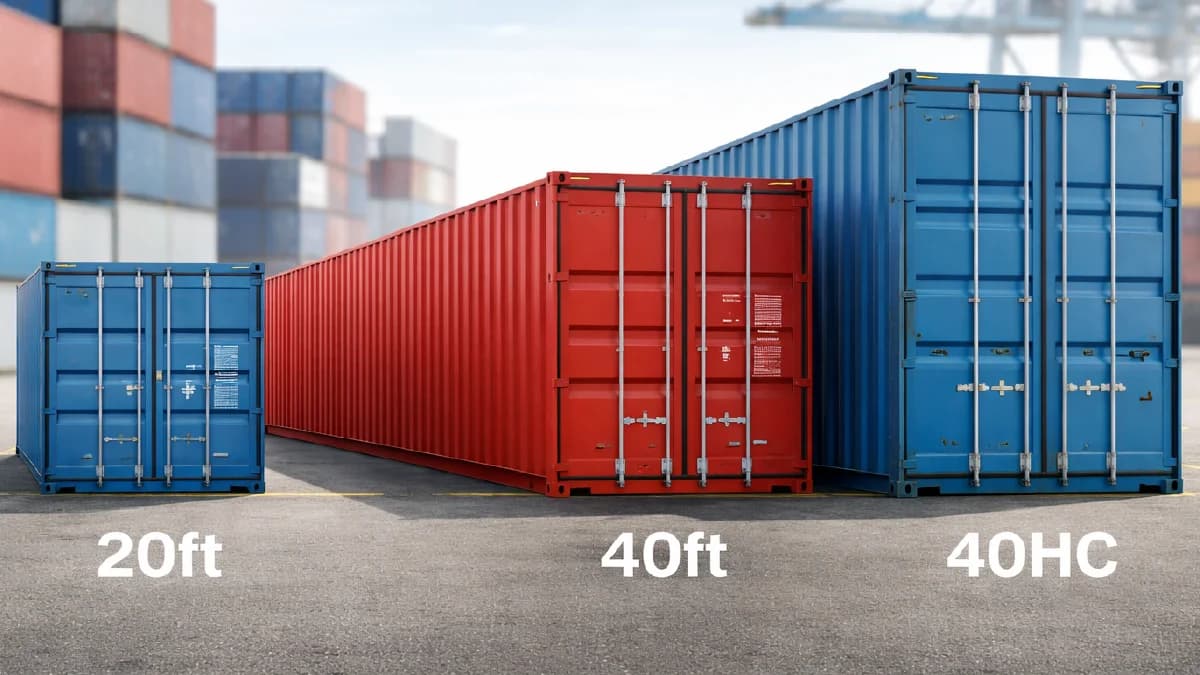
Container Capacity Reference
Understanding container capacity helps you decide between LCL and FCL:
| Container | Total CBM | Usable CBM | Max Weight |
|---|---|---|---|
| 20ft Standard | 33 CBM | ~28 CBM | 28,000 kg |
| 40ft Standard | 67 CBM | ~58 CBM | 26,000 kg |
| 40ft High Cube | 76 CBM | ~68 CBM | 26,000 kg |
Why "usable" differs from "total"?
You can't fill a container to 100% capacity. Cargo shapes vary, you need space for loading/unloading, and stacking limitations apply. Plan for 85-90% utilization.
When to Choose LCL vs FCL
CBM helps you make this decision:
Choose LCL when:
- Your shipment is under ~15 CBM
- You can't wait to consolidate more orders
- Cash flow is tight and you can't buy full container quantities
Choose FCL when:
- Your shipment exceeds ~15-18 CBM (for 20ft) or ~35 CBM (for 40ft)
- You need faster transit (no consolidation delays)
- Your cargo is sensitive and you want to avoid co-loading with others
- Per-CBM math shows FCL is cheaper
The crossover point:
For most routes, FCL becomes more economical than LCL somewhere between 12-18 CBM. Calculate both options for shipments in this range.
Common CBM Calculation Mistakes
Measuring the product, not the carton
Your shipping cost is based on carton dimensions, not product dimensions. A 20cm product in a 30cm box takes up the space of the box.
Ignoring irregular stacking
If your cartons can't stack neatly, you lose space. Odd-shaped packaging or fragile goods that can't bear weight on top reduce effective container utilization.
Forgetting pallets
If your goods ship on pallets, include pallet dimensions in your calculation. A pallet typically adds 15cm height and may add to length/width depending on overhang.
Not accounting for packing materials
Bubble wrap, foam, and other protective materials increase carton size. Measure the final packed carton, not the planned dimensions.
Optimizing Your CBM
Reducing CBM means lower freight costs. Consider:
Carton size optimization. Work with your supplier to minimize empty space in cartons. Right-sized packaging reduces CBM without adding cost.
Flat-pack products. For furniture or assembled items, shipping unassembled dramatically reduces volume.
Compression where possible. Textiles, soft goods, and some plastics can be vacuum-packed or compressed to reduce volume.
Mixed container loading. Combine dense, heavy items with light, bulky ones to optimize both weight and volume utilization.
Using CBM for Cost Estimation
Here's how CBM fits into your landed cost calculation:
- Calculate your total CBM using the formula above
- Get freight quotes per CBM from your forwarder
- Multiply: Total CBM × Rate per CBM = Ocean freight cost
- Add other costs: Insurance, customs, handling, inland transport
Example:
- Total shipment: 12 CBM
- LCL rate: $65 per CBM (China to Guatemala)
- Ocean freight: 12 × $65 = $780
Remember: This is just ocean freight. Your total logistics cost includes origin charges, documentation, destination handling, customs, and inland delivery.
Tools to Help
Manual calculation works, but tools speed up the process and reduce errors.
We've built a CBM Calculator specifically for importers. Enter your carton dimensions and quantities, and it instantly calculates total CBM, estimates container fit, and helps you compare LCL vs FCL options.
Final Thoughts
CBM is one of those foundational concepts that makes everything else in import logistics make sense. Once you can accurately calculate your shipment volume, you can get realistic quotes, compare shipping options intelligently, and plan your orders to optimize costs.
Take the time to measure accurately, account for packaging, and understand how CBM relates to your specific cargo. The few minutes spent on proper calculation can save significant money on every shipment.
Need help calculating your shipment logistics?
Avoid risks and get better pricing with our sourcing experts.
Frequently Asked Questions
Quick answers to common questions about this topic
CBM stands for Cubic Meter, the standard unit for measuring cargo volume in international shipping. It's calculated as Length × Width × Height in meters. Freight companies use CBM to quote prices for LCL (Less than Container Load) shipments.
Measure your carton in centimeters, convert to meters (divide by 100), then multiply Length × Width × Height. For example: 60cm × 40cm × 50cm = 0.6m × 0.4m × 0.5m = 0.12 CBM per box. Multiply by quantity for total CBM.
A 20ft container holds approximately 33 CBM (usable: ~28 CBM). A 40ft container holds approximately 67 CBM (usable: ~58 CBM). A 40ft High Cube holds about 76 CBM (usable: ~68 CBM). Actual usable space depends on cargo shape and stacking.