

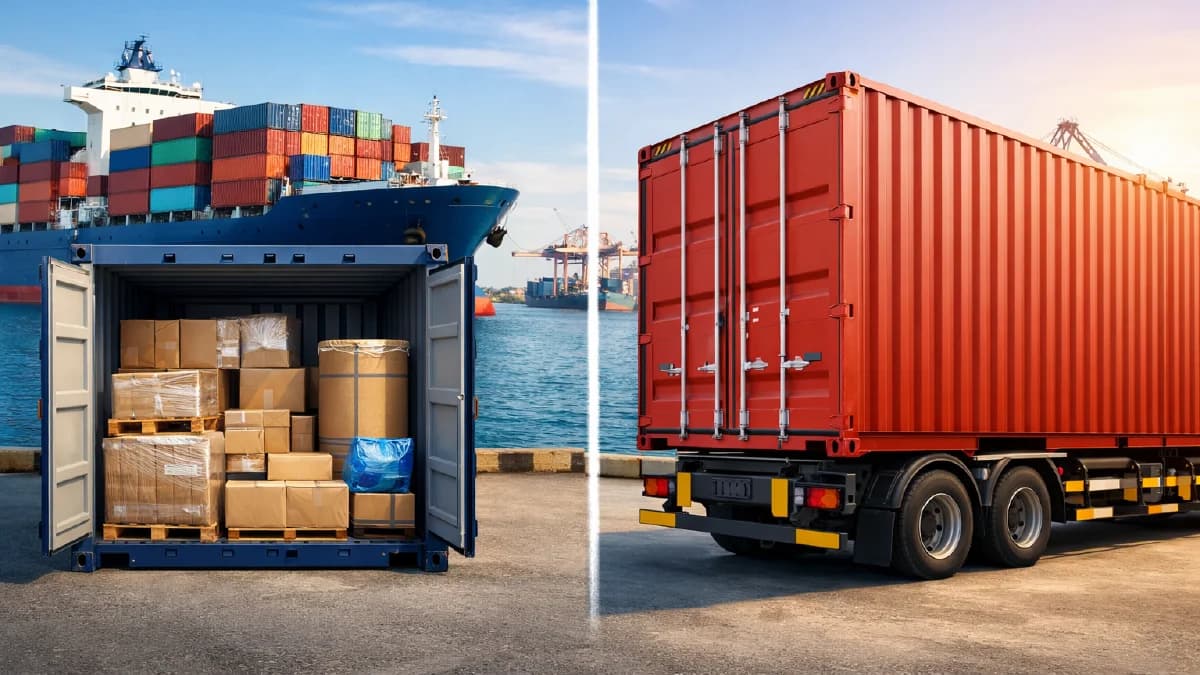
LCL (Less than Container Load) is usually best for smaller volumes and product trials, while FCL (Full Container Load) becomes more cost-effective and safer once your shipment approaches the break-even point where LCL total charges (freight + CFS/handling) match or exceed a full container rate.
For importers across Latin America, one decision can quietly destroy margin: should you ship LCL or pay for a full container (FCL)?
The correct choice isn’t based on instinct. It’s based on CBM, chargeable weight (W/M), urgency, and risk tolerance.
This guide gives you a practical decision framework your team can reuse shipment after shipment.
1) LCL vs FCL in simple terms
LCL (Less than Container Load)
Your cargo doesn’t fill a container, so it’s consolidated with other shippers’ cargo. Pricing is typically based on volume (CBM) or chargeable weight using W/M (whichever is higher).
FCL (Full Container Load)
You pay for a whole container (20’, 40’, 40HC). Your cargo moves in a sealed, dedicated container with less intermediate handling.
2) The real pros and cons
Why LCL feels attractive (and where it hurts)
Pros
- Lower upfront spend (great for trials).
- Flexibility for smaller volumes.
- Works well for uncertain demand.
Cons
- More handling (consolidation / deconsolidation) → higher damage exposure.
- More waiting points (CFS) → higher delay risk.
- “Hidden” fees add up (CFS, documentation, destination deconsolidation).
Why FCL scales better operationally
Pros
- Better security and control (sealed container, fewer touchpoints).
- More predictable planning.
- Lower cost per unit as volume grows.
Cons
- Requires volume/cash flow.
- You pay for unused space if forecasting is weak.
- Inventory risk if you overbuy.
3) How costs are typically calculated
LCL (consolidated)
Common components:
- Ocean freight per CBM (or W/M).
- Origin CFS fees (receiving, consolidation, docs).
- Destination fees (deconsolidation, handling, release).
Key concept: W/M (Weight/Measurement). You’re charged based on the higher of volume or chargeable weight.
If you don’t have a CBM workflow yet, use a calculator to validate dimensions:
CBM Calculator (Seafreight)
FCL (full container)
Typical components:
- Container ocean rate (20’/40’/40HC).
- Origin terminal charges + documentation.
- Destination terminal charges + release.
- Inland trucking (often a big LATAM cost driver).
4) Transit timing: what changes between LCL and FCL
The vessel route may be similar, but the process is not:
- LCL usually includes extra time for consolidation and deconsolidation.
- FCL moves with fewer intermediate steps.
If your shipment supports a promotion, seasonal demand, or tight replenishment cycles, FCL is often more stable.
5) Typical LCL risks (and how to reduce them)
Common risks:
- Damage due to extra handling and mixed cargo stacking.
- Delays due to consolidation timing or inspections affecting other shippers.
- Documentation mismatches across multiple parties.
Mitigation:
- Strong packaging + proper palletization.
- Clear carton labels and pre-loading photos.
- Avoid LCL for highly fragile or claim-heavy products.
- Use forwarders with reliable CFS operations and traceability.
6) Break-even: when does FCL become cheaper?
There’s no single global number because it depends on route and season.
But the logic is consistent:
FCL wins when:
- Total LCL costs approach or exceed a 20’ container rate, or
- Your cargo occupies a meaningful share of the container, or
- The risk/time cost of LCL is higher than the rate difference.
Best practice: always ask your forwarder for two quotes on the same purchase:
- Option A: LCL (all-in)
- Option B: FCL (20’ and/or 40’) and compare landed cost per unit.
7) A simple decision checklist
Choose LCL if:
- You’re testing a supplier or a category.
- Volume is low and demand is uncertain.
- You need to protect cash flow.
Choose FCL if:
- Demand is stable and repeatable.
- Timing and product condition matter.
- You’re building a recurring import operation.

Want an LCL vs FCL quote comparison for your next shipment?
Avoid risks and get better pricing with our sourcing experts.
Frequently Asked Questions
Quick answers to common questions about this topic
LCL (Less than Container Load) is consolidated cargo: you pay by CBM or chargeable weight and share a container. It’s ideal for smaller shipments, product trials, and irregular purchasing.
FCL (Full Container Load) is a dedicated container: your cargo is loaded, sealed and shipped without sharing space. It’s ideal when volumes grow or when security, control and timing matter.
There’s no universal number. As a rule of thumb, FCL starts to make more sense when total LCL charges (freight + CFS + handling + destination fees) approach a 20’ container rate, or when your cargo occupies a significant portion of the container.